Friday, September 7, 2012

Science Lab is DONE!

The construction of the science lab is officially complete! Thank you to everyone who donated and sent positive thoughts towards this project; without all of you, the lab would have never been possible!  We started construction once I received the money in June.  Since June, the mason that I hired has tirelessly put forth the effort to get the construction done before the beginning of the school year and before my departure.  It hasn’t been easy with rainy season being so relentless this year, but we got it done!

The beginning stages....getting the lab tables built.


Getting the septic system built for the drainage of the sinks.  


I spent my last few months as a Peace Corps volunteer traveling back and forth between Pagala, Tchamba, and Lome.  As an organizer for Camp UNITE this year, it’s been hard to stay put in Tchamba to make sure all the work was taking off well.  Luckily for me, I have so many great counterparts who stayed on top of it.  I came back to Tchamba any chance I got to buy more supplies to tie over the workers until I could come back again and buy some more.  After 3 months of hard work, the science lab was officially built!

Putting on the final touches

All done!!

With running water too

The storage room with fancy closets for the materials.

Some students painting a large world map on the side of the science lab

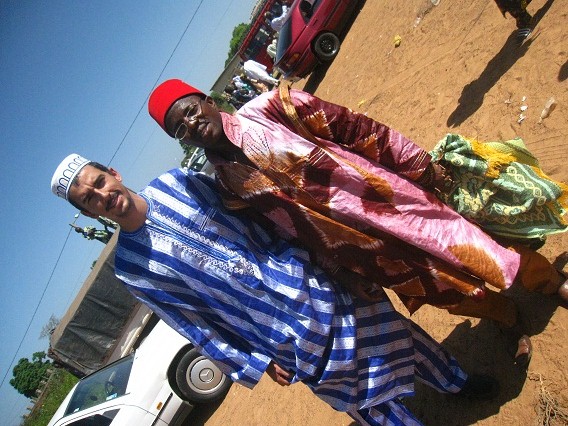
We inaugurated the lab on August 31.  I wanted to get away without a big ceremony, but my counterparts insisted that it had to happen.  So, together we called up all the important people in town and we held a 20 minute ceremony to cut the ribbon on the lab.  To my surprise, the Parent Teacher Association gave me a gift of traditional woven cloth, worn by the Tchambas (or would they be called Tchambains? I’ve never figured it out)
All the authorities

Putting the ribbon on

The Prefet cutting the ribbon.  I dont know what prefet would translate into English....the person who is in charge of a county? 
The whole group at the ceremony

Getting dressed by the Prefet and his wife who is also the president of the PTA.

Me and Charundine, the mason.

Everyone was so pleased and impressed with the lab!  Tchamba’s only high school is finally taking a step in the direction of becoming a well-equipped establishment.   Thank you again to everyone who donated! I took the names that appeared on the donor list that Peace Corps sent to me and had them written on a plaque and nailed to the wall.  The names on the donor list were everyone who didn’t want to remain anonymous; if you donated and don’t see your name on there, please know that Tchamba and I appreciate your donation very much!!


Sunday, May 6, 2012

Men as Partners

Yesterday I wrapped up my Men as Partners workshop.  Men as Partners (MAP) is an approach to teach gender equity through a series of activities that engages the participants in debates, games, etc.

I've been using this approach to talk about gender equity on a small scale to the local Imams (muslim leaders).  They have really appreciated the tiny 8 person workshops, and I was happy doing it on a small scale.  But, back in February, I was approached by the founder of Luciol'Envol (http://www.luciolenvol.org/) to see what kind of partnership Peace Corps volunteers in Tchamba could form with their organization.  Luciol'Envol is a pretty amazing association.  It was founded by a man who was born in Tchamba, went all the way to university in Togo, and is now working at CDG airport.  Every year he provides scholarships for 50 tchamba girls to attend school in honor of his mother, who he says is the reason why he was able to go so far in his studies.

I talked about my work with the Imams, which got everyone in the association interested. Together, we thought of a Men as Partners training for the chiefs of each of the neighborhoods in my village, the CVDs (the person in each neighborhood in charge of community-development), and the woman responsible for women in each neighborhood.  All together we had about 50 participants.

The day started early with an opening ceremony, followed by sessions on defining gender vs. sex, gender roles, HIV/AIDS, breaking gender stereotypes in households in regards to chores, work, and education, and finally a session on the meaning of family and what it means to take care of family.

The whole day was in local language (tchamba).  I can really see a huge difference in a training that is held in local language vs. a training that is held in French.  French is rarely someone's first language here, so a lot is lost varying from each participant and how much french they know.  By having the training in local language, it really provides for a better comprehension, more participation, and more fun as people are comfortable making jokes in their native language.

Our Training of Trainers: 5 trainers 'examining their attitudes' through debates. 

Opening ceremony with the village authorities.  Can you imagine having a workshop in America and having the mayor, his council, religious leaders, and education officials all coming?

Talking about the difference between sex and gender.

Discussing gender stereotypes in Togo.

Yay! At the end of the day, everyone got their certificate.  (If you don't give a certificate here, it's like the workshop wasn't official)
Me with the trainers that led the sessions during the workshop! (People were so surprised I opted out of printing a certificate for myself...)

24 years old..

I celebrated my second birthday in Togo this past April 25th.  To celebrate, I decided I wanted to throw a party for me and my neighbors.   I’ve never really invited any of my neighbors over to eat a meal with me, so I decided this would be the best time and way to do it.

I got my party planner and best girlfriend in Tchamba to help me out with all of it.  Together we sat down and planned a meal for 40 people.  The meal entailed a salad (cabbage and hot dogs), followed by couscous with wagash (cheese from fulanis, a nomadic tribe), two chickens, one of them being my pet chicken (his name was garbanzo), and sodas for everyone.  I also baked about 4 loaves of banana bread to have as my cake.


Some of my neighbors.  I promise, they were more excited than this pictures lets on.


Some of the kiddos in the neighborhood.
Lyle and Christa happened to be swinging through Tchamba on their way back from Benin so we all got to party together!

The closest people I have in village to a host mom and dad (since I don't live with a host family).
The chicken was in a seperate bowl from the couscous.  I kept wondering when Angel was going to pass it out, but she never did.  Finally we sang happy birthday and cut the cake.  After everyone got their cakes, Angel passed out the chicken (the real dessert). Everyone eats meat last here, even when there is cake.

Angel and me wearing the necklace she gave me for my birthday!

People actually gave me presents! I was SUPER shocked since most people don't have money to just buy whatever, whenever.  I got a ton of cookies, dates, a porcelain bowl (left of the photo), a wheel of wagash (cheese), the necklace from Angel, and a new pair of flip flops!


The party was a super success and I really loved having everyone over.  Everyone sang happy birthday, in both English and French, ate a ton, and ended up having a little dance party at the end.  I can't believe I'll be leaving this neighborhood soon! This is the first time in my life I have 1) lived alone and 2) actually been really good friends with all of my neighbors.  It's relationships like these that are hard to find in America, and I'm really lucky to have found them here.

Friday, April 20, 2012

Fully Funded!

The science lab project has been fully funded!! I don't know how to say thank you to everyone who donated; it was such a surprise to see it get funded so fast! I'm one lucky girl to have such an enormous amount of support from home.

Here is the classroom that we will be turning into a science lab:

The floors will be cemented (it's just a dirt floor now), and 5 tiled lab tables will be installed with a sink in each one.  

In addition to the classroom, the school donated a storage closet and an office.  We'll put the science materials in this closet.  


I now have one more community meeting and construction will begin once I receive the money! I'll continue to post pictures as we go along.  It's so exciting to see this project come together.  I remember when I first got here talking to Djeri (the science teacher) about the possibility of putting a science lab at the high school.  I wanted to wait until I was sure the community was motivated and that this would be a worth-while and sustainable project.  After being here for a year and a half and working with the science club and the school, I'm really excited to see this project take off.  This is truly a community worth investing in, with motivated and dynamic members!  Thanks a million times for all the support everyone has shown me and my community!

Wednesday, April 11, 2012


Angel is 24 years old and is in her senior year of high school. (It’s very common for high school students to be anywhere between 15 years old and 30 years old). When she was a sophomore in high school, she became pregnant with her twin boys, Fabian and Fabrisse.

Pregnancy almost always puts an end to educational and career orientated goals for a Togolese girl.  Once pregnant, the girl will drop out of school to take care of her child.  Angel’s incredibly supportive family encouraged her to return to school once her twins were born.  The family all pitches in to take care of her kids while she is at school and at night while she studies.

Despite being away from school during the day, Angel always finds time and energy to play with her twins after school and during the weekends.  She is a dynamic young woman that understands the importance of family, education, and preparing for her future. 

Angel is the president of the Tchamba Science Club, a club that meets once a week to perform science experiments.   She has taken the responsibility of planning all the activities for the club, thinking of fundraising efforts for the club, and encourages her peers to attend.

Angel hopes to go to University next year to studying agronomy.  Her passion to become an agronomist is evident; her entire yard is a garden of vegetables and moringa trees, which she shares with her neighbors and teaches them about nutrition.

By donating to the Tchamba Science Laboratory, you will ensure a brighter future for Angel and young women like her.  It is difficult for any student to comprehend the complex nature of science by solely practicing rote memorization of theory. Furthermore, girls often do not enroll in science classes; they are discouraged by their peers and often cannot succeed in a class when boys out-number the girls 8 to 1.  With this science lab, students will have the opportunity to learn hands-on, and girls who are already against unfair odds will build the confidence needed to continue with a scientific future.


Tuesday, April 3, 2012

Science!

I cannot imagine going through high school biology, chemistry and physics classes without having a lab component to see what I learned play out in practical activities.  Togolese students are expected to learn, memorize, and understand what their teachers lecture to them each day.  But with the lecture-based methods, students never have the opportunity to see science come to life.  On top of it all, Tchamba has all the necessary science equipment for experiments, just no environment to actually carry them out!

Help my bright students better comprehend the sciences by donating to the Tchamba Science Lab! This lab will not only give the kids a chance to run experiments, learn in a participatory manor, and be a hands-on way of learning, but it will also encourage girls to pursue the sciences as well.

Girls in the Tchamba high school are outnumbered by boys almost 8 to 1.  Girls are afraid to speak out or ask questions because they are afraid of boys teasing them and also because Togolese culture encourages them to be timid.  Few girls are enrolled in science classes, because science is tough! And without a full support system, the opportunity to ask questions or participation in class, girls fall unnoticed.  Give the girls the opportunity to learn science in a manner that is more conducive to individual learning, thus building their courage and their future in science.

Click here to be a part of this project:
https://www.peacecorps.gov/index.cfm?shell=donate.contribute.projDetail&projdesc=693-400&fb_source=message

100% of your contributions will go directly to building lab tables, installing sinks and plumbing equipment, installing electricity, and ensuring that there is proper drainage. I'll be sure to update you with photos of the construction as we go along! Plus everyone who donates will have their name painted on the wall of the science lab!

Djeri, the science teacher, teaching the students of the science club how to make  bleach The science club is comprised of 50 students and meets once a week.  The club either does review or experiments each week, but they are extremely limited by the room size and number of resources.

The science teacher encourages girls to prepare the experiments to teach the class.  Here, the girls are showing the club electrolysis of water.  Your donations will give the chance to every girl at the high school to understand and perform exeperiments!


The club breaking up into teams to race which team can solve a sudoku puzzle fastest!

The club crowding around the one table to see the experiment.   The science lab will ensure that every student can be a part of the experiments, rather than 50 kids surrounding 1 small table.

Saturday, March 24, 2012

"Lauro de Alafia" is the women's reproductive health conference I did during the end of January.  I recently wrote an article about it for the CHAP (our health sector) newsletter, so I decided I should post an edited version of it up here.

Lauro de Alafia: A Conference for Women’s Health and Empowerment

This year I had the pleasure to carry the Peace Corps torch for the thrid year of “Lauro de Alafia”.  “Lauro de Alafia”, or “Women’s Reproductive Health” in Kotokoli, is a four day health and empowerment conference targeting 20 rural Muslim women.   Specifically, this conference was to give rural women who did not go to school a chance to learn about the reproductive system, family planning methods, and strategies on how to approach their husbands about family planning.   The women were chosen by their local red-cross mothers club in the Tchaudjo and Tchamba prefectures.  We asked each village mother’s club (10 in total) to send two women.  We asked that both women were animated and motivated, but that at least one could read in French. 

Group Discussion 

This conference was unique in the sense that it was held entirely in local language.   Most of the women in the conference had none or very little French skills.  Seeing how I do not speak Kotokoli, the success of this conference was all thanks to my wonderful counter-parts. Together we made the schedule, created the budget, and picked facilitators that would help us with the conference.  The facilitators we invited were already knowledgeable in the fields they would present.  The sessions on health and reproduction were held by women who work in the hospital, the sessions on gender equity and strategies to talk to husbands were led by Muslim men who have participated extensively in previous Men As Partners projects, and HIV/AIDS sessions were led by a member of EVT(local HIV/AIDS NGO) in Sokode.

Activities for the conference:
  • Presentation of the goals of the training, Definition of sexual reproductive health, and the importance for women
  • The reproductive life cycle for women and men (childhood, adolescence and puberty, adulthood and menopause)

Learning about male anatomy
  •   Pregnancy
    • What are the steps from becoming pregnant to birthing a child?
    • Biology of Pregnancy: How to be in good health during pregnancy?
  • Basic Hygiene and Sexual Health
  • Risk of the 4 « Trops » and Polygamy
  • Family Planning : Why use family planning ?
  • Different methods of family planning
  • Promotion of Positive Behavior : Talking to our daughters about sexual health

Condoms donated by Population Services International
  •  IST/HIV/AIDS

                -the realities of HIV in Togo
                -Modes of transmission of HIV/AIDS
                -Prevention
                -Women and HIV
                -Importance of being tested for HIV/AIDS
  • Gender Equity : How can we encourage gender equity in our villages ?
  • Talking to your husbands about family planning

*This session taught the women different techniques and strategies on how to approach their husbands about family planning.  This is a difficult subject, especially in Muslim communities.
  • How to animate a session on family planning and reproductive health in your village.
  • Income Generating activity : Neem Lotion and Feasibility Study

*I am a GEE volunteer so I used this time to talk about the importance of sending their girls to school.  This is the one session I lead with a counter-part to translate. We talked about the obstacles of sending our daughters to school and how to overcome them.  We made a list of potential IGAs, I taught them Neem Lotion along with the benefits of prevention against malaria, and then learned how to do a feasibility study.
  • Candlelight vigil

Learning how to make Neem Cream as an Income Generating Activity

  •  Women’s Rights
  •  Go to local hospital to animate sketches on family planning

At the hospital, getting ready to perform a skit
To fund “Lauro de Alafia”, I applied for USAID's Small Project Assistant funds.  The money was enough to pay for each woman's transportation to the conference and her room and board.  Each village (2 women) took home two packets of typed notes with information from all the sessions in French, a boite d’image (a book with pictures and captions), a wooden penis and a ton of condoms (Thank you Winnie and PSI!!).  

This project has been one of the most rewarding projects I have ever been a part of.  Despite not understanding what was going on 90% of the time, I could see the women’s faces light up with interest.   This was an intense conference packed with sessions, and not one time did I feel the women losing interest.  The women left feeling confident, excited to have participated, and enthusiastic about sharing the information they learned with their friends, daughters, and husbands.  On top of it all, I did practically nothing!  The organizers and facilitators took control and did a fantastic job; a Peace Corps volunteer’s dream!  


Friday, March 16, 2012

Ok, so America is great. But so is Togo.

I'm back in Togo.  Actually, I've been back from America for about 3 months now, but I've been super suuuuppeerrr busy!

America was awesome, as expected. But what was not expected was how my trip home would change the way I view my life here in Togo.  At the end of my two week trip, I was all sorts of ready to head back.  I know I previously wrote how things that frustrate me in Togo, but I realized that there are equally as many things that frustrate me in the States.  It's totally normal, and expected to have those feelings anywhere in the world you are.  The whole time I've been in Togo, I fantasized about being in America.  Once I was actually in America, I couldn't stop thinking about my life in Togo.  Now i'm back and happier than I have felt in a long time -- even after being back for over 3 months.

I will, however, take the time to appreciate...
Seeing my family and friends.  I've missed them tons.
Hanging out in DE with the boy and his family.
Driving in a car...not in a taxi stuffed with 10 more people than there are spots.
HOT showers and getting that layer of dirt off my body that I cannot seem to escape here.
Eating cake popsicle things (what are these?! these are amazing.)
Basically, just eating whatever I want, when I want. (I had 3 lunches one day. Oh and I gained back 6 of the 10 pounds I've lost since coming to Togo in two weeks. Oops.)

And I won't forget to tell you what I did miss...
Seeing the watchi lady every morning to get my fair share of rice, beans, and noodles in the morning.  I came back and found out she is pregnant!
Playing with the twins next door, seeing them grow up.
Sitting under a tree and just people watching for a while.
Riding my super sweet Trek bike around town.
Motorcycle taxis to Sokode.
Getting to be a part of amazing projects that I would never in a bajillion years get a chance to do in America.

I love Togo.  It just took a little reminder of the life I've lived before to see how special I have it here.


Monday, December 12, 2011

I AM FREAKING OUT! I WILL BE IN AMERICA IN 6 DAYS!


So I am just going home for a brief visit to hang out with family and friends during the holiday season, but I don’t think I have ever been more excited about a vacation in my LIFE.  And it’s to a place I’ve lived for 22 years.  Of course, I’ll be doing new and fun things like hanging out with the boy in nyc and meeting his family, but I’ll be right back to the old and the familiar DFW metroplex after a few days.

So why am I SO excited? More than any other trip I’ve ever taken? Because I need a serious break from this Togolese life.  Don’t get me wrong, I love Togo.   I love my village, my house, my neighbors, the cute babies, and all the people I’ve met.  Rice and beans have become a comfort food…I think I crave them more than I crave cheeseburgers now.   So what’s up? Why have I been feeling blue lately? I think most of this blog has been about the amazing kick ass times I’ve had, but rarely do I ever go into if I ever feel frustrated or sad.   Being a Peace Corps volunteer isn’t all about holding cute babies and sharing cultures, it can also be frustrating and eye opening.

Reason #1: I am tired of getting sick!! I’ve had more ailments here in Togo than my entire life (probably an exaggeration).  Yes, part of it probably has to do with the way I take care of myself, but a lot of it has to do with the fact I’m living in Africa.  A general list of maladies I have had since coming here: Colds, Food Poisoning, Malaria, Amoebas, Pink Eye, Bronchitis, Gall Stones (I’m not sure if I believe this one),  and general other stomach pains that I have no explanation for other than the fact I eat street food every day...

Reason #2: Work here is hard. 


I have had more failed projects here than I’d like to count.  English club at 8:00AM on Saturdays? Nice try, but no way are people coming to that one.  Computer Club? HA, half of the computers are broken today.  A funded project that you wrote a grant for and got approved to receive funding for? Woops, your check is still somewhere in the DC vortex.  Getting stuff done here is HARD! I guess the major problem is that I see so many avenues for projects, but finding the time, the resources, and the right motivated people can really just bog you down.

While this is a huge reason why I am frustrated, it’s not the end of the world.  I have had some incredibly successful projects, such as starting a new science club at the middle school, the high school science club which is entirely run by students, Leve-Toi Jeune Fille, various summer camps,  working on the UNITE team, etc.  It has just taken some time to slow down my American-Paced attitude about work and getting things done right away. 

Reason #3: I really really really miss America.   I miss having privacy.  I miss not hearing “WHIIITTEEE PEEAARRSSSOONN” being yelled at me once I step foot out of my door.  I miss going to a grocery store where I have options. I miss going swimming. And most of all, I miss my family and friends.  Life is going on with or without me in the states and that has taken a lot of adjusting to get used to.

So, I’m off to America to recharge, to get my fill of draft beers and cheeseburgers and Mexican food, to see my lovely friends and family, and to put my life here in Togo back in perspective. But after all of it, I know I’ll want to come back to Togo; I have a life here! I have a house, a cat, a best friend for a neighbor, a boyfriend, and so many amazing volunteers I love hanging out with.

Monday, November 7, 2011

Happy Tabaski! Or Happy Eid al-Adha for those not in West Africa!

FAIR WARNING!: these pictures get kind of gross.

Yesterday was Tabaski, the “festival of sacrifice”.  It celebrates Abraham’s willingness to sacrifice his son for God, but God stepped in and Abraham only had to sacrifice a sheep instead.  This is the holiday of holidays for people in my village.  I would say it is the closest thing to Christmas (not in a religious context, but more for the intense amount of celebration).  Everyone puts on their finest clothes, spends insane amounts of money on a family animal to sacrifice, and parties it up with sodas and treats. 

Looking REALLY good.

In the morning, Justin and I got all dressed up in our Togolese-finest to go to prayer.   Men and women must separate for prayer; the women have to pray behind the men.  Because of this, Justin went off with my neighbor Salim and I went off with my two friends Nahid and Whitney to go pray with two women we work with at the hospital.  We headed off to our colleague’s house to learn how to properly wash ourselves before prayer. 

Learning the steps to washing.
Justin and Salim

People from Tchamba (pop. around 13,000) went to the central elementary school to all pray together.  Hoards of people packed in the courtyard and laid out their prayer mats to stake a place to pray.  There were people riding horses, beating on drums, and selling popcorn and treats everywhere.  Tabaski is also the time to give to the poor, so people were shelling out coins left and right to give to those asking.  

Cute girls at prayer

At 9am the Imam started off with the prayer.  I have never prayed before so it was a lot of me watching out of the corner of my eye to see what others were doing.  It was an amazing experience to see a sea of women in veils praying all at the same time.  In muslim prayer there are several steps that start with one standing, then one bends down, then one sits with forehead to the ground.  Imagine hundreds of people doing that all in sync!
So many people! This is only a tiny tiny portion.


Nahid, Wembe, Whitney, and Cherifa

After the prayer, which only lasted maximum 4 minutes, we all filed out and headed back to our colleague’s house.  They had made a delicious meal for us of foufou, rice, and cous cous with a ton of beef in it.  We ate as much as we could but knew that there would be more meals for us to go to later on that day. 

Rice, foufou and couscous

On my way home, I certainly saw the essence of a “festival of sacrifice” as goats, sheeps, and cows were being slaughtered in the streets.  I headed straight to Salim’s house where I found Justin, scarred from the mass-slaughter he had witnessed.  Apparently, he had gone around with all the men to kill the various animals in my neighborhood.  (By that, I mean Justin took his camera around and followed everyone blindly into one situation after another).

Sweet little Manaf ignoring whats happening behind him

Salim's impressive cow.  He's so proud!
Each family sacrifices one animal for this holiday.  1/3 of the animal goes towards the family, 1/3 of the animal goes towards friends, and 1/3 of the animal goes to the poor. (I now have a freezer full of beef that I’m currently googling marinades for).  Animals are CRAZY expensive with cows going for $600! Needless to say, this is a huge deal and families are super proud of their haul.

The family across the street and their lamb.  (You can't tell in this picture, but they were going pretty nuts).
The rest of the day was spent at my friend Moctar’s house.  His family cooked up another meal of foufou with sesame sauce (yum) and a yummy salad.  After that we headed to his brother’s dege (ice-creamish stuff with couscous inside) shop to indulge in their Tabaski gift to us, free dege!

There were a ton more celebrations happening throughout the night but I decided to turn in early and rest up.  I just got over having pink eye in both eyes and my eyeballs are still pretty dry and get tired quickly.  Plus this party lasts for 3 days!